
A “life story” lived with the students of the Manoleasa Gymnasium
The meeting at the Manoleasa Secondary School
from Activity 3.4. Providing anti-discrimination education, active citizenship and the promotion of successful models for children and youth at risk of dropping out of school and/or learning and psycho-behavioral difficulties
My educational experience (Lecturer Dr. Marius Eși [1]) augmented through my participation as a trainer-expert providing health education in the project „Integrated children and youth for a better world”, financed by the call “Inclusive education for children and young people at risk” and implemented within the Local Development, Poverty Reduction and Enhanced Roma Inclusion Programme.
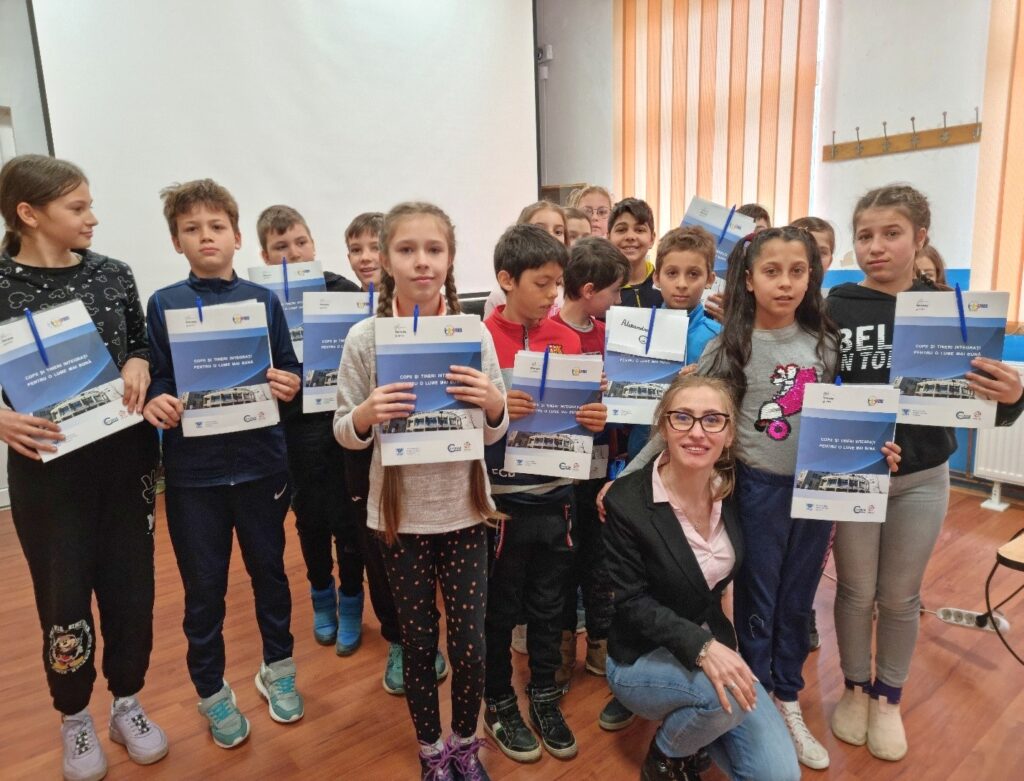
I say that my experience has become richer precisely because I want to reproduce some of the facts and events that took place in the framework of such an educational endeavor. From the very beginning of the meeting, when the 4th graders, my future students for a few hours, were introduced to me by their distinguished teacher, and when I felt a flow of positive energy that would last until the end the meeting.
The place of the meeting was a deeply spiritual one where the Romanian tradition is at home in all its forms: rural time and space, language rich in regionalisms pleasing to the ear, very good communication from all those involved, a beautiful simplicity and a specific wisdom.
From the very beginning of the lesson, my new students proved to be true educational detectives. They were staring at me and scanning me, at first with some curiosity, a slight panic (because their teacher had been gone for a few minutes), but at the same time, eager to know and learn more from me and even about me.
 I briefly told them who I was and explained why I was with them at that moment. I spoke to them calmly, with a smile on my face, and during the speech I made another joke, well controlled by me (another subtle moment of breaking the ice), so that I could slightly attract their attention and, why nay, to relieve them of the slight tension and anxiety arising from the fact that they were at that moment face to face with any other than their lady teacher. As I was talking to them, I noticed how their faces showed smiles, they started to giggle, to laugh, to feel good.
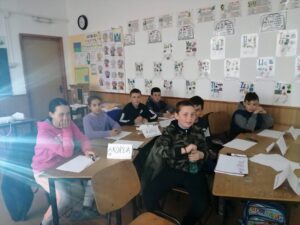
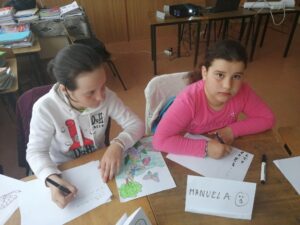
After this first step, I moved on to deepening the previous phase, an interpersonal knowledge exercise when I asked them to write their name on a piece of paper and display it on the bench. Then I asked them to introduce themselves, tell me their name, who is their best friend, if they like school, what is their favorite subject, etc. I don’t want to tell you how eager for communication they began to become at that moment and how much they began to tell me about themselves, about school, about their joys. Every time someone spoke I made sure to reward them with a smile or a “Bravo!” full of encouragement and joy. They almost always responded the same way with a smile or a giggle as confirmation that they were feeling good.
Slowly, slowly we moved the discussion towards what was to be the purpose of our meeting, namely a discussion of the ideas of discrimination and anti-discrimination. I was pleasantly surprised to find that some of them were trying to answer my questions about the idea of discrimination. I noticed that on an intuitive level they knew what it was about, they just needed, perhaps, a confirmation, some additional explanations. The surprise was all the greater given that none of these children previously knew what topic I wanted to discuss with them.
After about 5 minutes of discussions, questions and nice and interesting answers from them, I told them that I want to make some teams together so that we can play better. I gave them some colored pencils, crayons and sheets of paper and told them that we would draw and write together later after I wanted to show them two animated videos about discrimination.
Throughout watching the videos, I noticed that my new students were very attentive so that later they successfully coped with the discussion. So, after watching the videos we tried to discuss together the main idea about the message. I want to tell you that I didn’t even get to formulate the question because my students were raising their hands asking me to let them answer, the raised hand being completed at that moment with the request expressed verbally, “I say!”, “I know!” “I want to answer!” s.a.m.d. They were eager every time to answer, to communicate, to talk with me, to explain, to show me what they understood.
I was assaulted, overwhelmed, conquered by their personality, their way of being.
My intervention consisted in the fact that I confirmed most of the answers they gave me, at the same time explaining to them what they saw in the videos. Thus, I tried to explain to them what gender discrimination means, or social status discrimination, discrimination in social life or concepts such as discrimination and anti-discrimination, equality, respect, help, tolerance, kindness, etc.
The second phase then started with team work. Thus, I asked the students to try to draw together what they understand, what they imagine by the idea of discrimination or discrimination. I also recommended them to try to recall images, facts, words, sayings from the videos they saw. And this time I analyzed them very discreetly, sometimes I gave them little advice, suggestions regarding the task they had to perform. I really enjoyed seeing how they talked together, how they drew and colored together, but also how they laughed together.
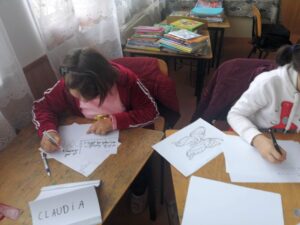
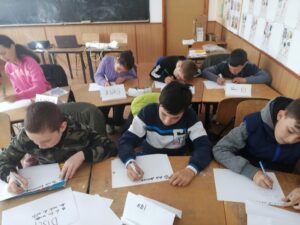
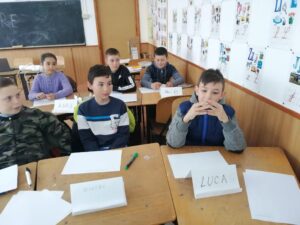
After the time was up, each team presented their drawing in front of the class. Also, one of the tasks was for each member of each team to say a word or a sentence related to the given task, to the ideas of discrimination and anti-discrimination. Every time one of the students finished speaking, everyone else applauded as a form of reward. Also, at the end everyone cheered for each team.
The third phase of the didactic activity took place with an active learning method in the center of attention, namely the role-playing game. The three teams were tasked with imagining a discrimination/anti-discrimination situation and presenting it physically. Such a concrete and playful approach was a real success because the little ones like to play, to imagine all kinds of situations. And this time, after the well-deserved applause and after the smiles and joy of the task well accomplished, we moved on to the last stage of the didactic activity.
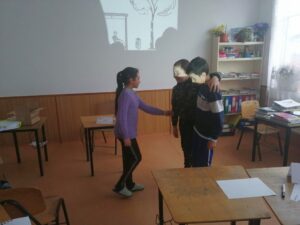
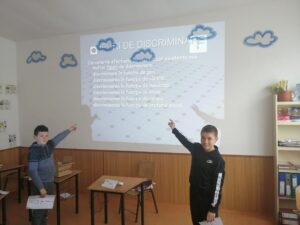
The fourth phase consisted in concretizing a moment of feedback. Thus, he asked the students to remember what they discussed and what they remembered after the activity. And this time the answers were up to the mark, the students doing very well.
The activity made the time compress and the joy remained on everyone’s faces. At the end of it, we all enjoyed a very good and tasty ice cream, parting with handshakes, with a slight regret and with the hope of an equally beautiful and pleasant reunion in the future. There would be much more to say about such an educational approach, beyond the emotions felt by each participant.
I can only say that I met some wonderful children full of life, restless in the good sense of the word, eager to know, to color, to communicate. They always tried through the behavior they displayed to express themselves in a personal way, to show what they did, what they know or what they learned during the activity carried out. It is certain that the education of children is like a flower, a flower that always needs to be watered, sprinkled with a lot of care and affection, so that it is pleasing to the eye whenever it is looked at. Let’s not forget that education can only be perfected and transmitted through the children we always have close by, beside us, as educators, because, basically, they teach us how to laugh, smile, enjoy everything moment in our own lives.
Suceava, 11.04.2022
[1] Marius Eși is Lecturer in the Psychopedagogical Department of the Faculty of Educational Sciences, “Ștefan cel Mare” University in Suceava, with over 12 years of experience and teaches subjects such as: Didactics of the specialty, Didactics of the field and development in the didactics of the specialty, Pedagogical practice.
Read MoreThe “path of knowledge”, traveled together with the students of Bilbor Secondary School
The meeting at the Secondary School “O.C. Tăslăuanu” Bilbor, within Activity 3.5 – Provision of health, hygiene and nutrition education for children and young people at risk of dropping out of school and/or learning and psycho-behavioral difficulties
My educational experience (Lect. dr. Monica TURTUREAN[1]) augmented through my participation as a trainer-expert providing health education in the project „Integrated children and youth for a better world”, financed by the call “Inclusive education for children and young people at risk” and implemented within the Local Development, Poverty Reduction and Enhanced Roma Inclusion Programme.
I was greeted with many smiles and good cheer at the Secondary School “O.C. Tăslăuanu” Bilbor (Harghita county), where I met a group of curious students eager to learn new things. They welcomed me as if we had known each other forever, I felt a lot of warmth and a feeling of well-being in their souls.
We started with an ice-breaking exercise, where everyone had to introduce themselves and say three attributes about him/herself, then three characteristics of the bank colleague. They responded promptly to both requirements without feeling inhibited or embarrassed at all. Moreover, they knew their colleagues very well, which gave me the impression that there was good communication between them. After this exercise, I moved on to discussing why we were meeting, asking them to engage in all the activities I proposed. We had a unanimous YES.
I handed out worksheets that included information related to body hygiene, home hygiene, physical health, school and playground/park safety. Some applications were individual, others involved teamwork; I was pleasantly impressed by their naturalness, but also by the spirit of solidarity, of helping each other: they lent their carios and colors to each other, they politely waited for their turn to use the coloring tools, there was no envy and malice, only the desire to respond and to be appreciated. They were grateful when I gave them the long-awaited feedback (“Very good!, Bravooo!!!, Wow, what a nice answer!!!”) and they couldn’t wait to see the next exercises.
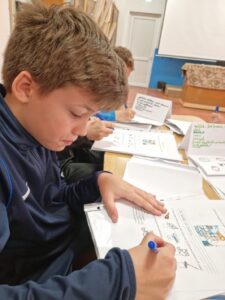
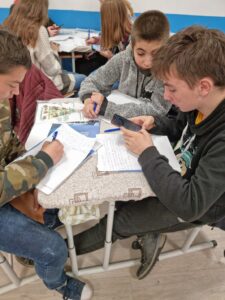
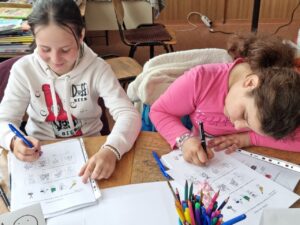
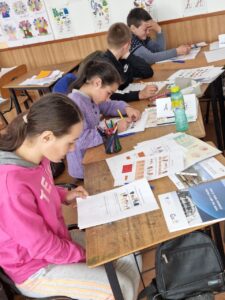
The atmosphere was very relaxed, engaging, and my discreet interventions had the role of stimulating the discussion. Questions related to hygiene and healthy eating wanted to be answered as fully as possible, and the students had a great need to feel validated throughout our meeting; we took care of this aspect, which was by no means free, but was a consequence of their involvement, of the fact that they responded with interest. They constantly had their hands raised, they found new explanations for everything I asked, they looked with great interest for other examples than those provided by me to show me that they know, that they master a lot of information, but also because that’s how they saw learning, as a total involvement, no mean lines and no raising of the tone.
In the next stage I showed them two short films in which they had to identify what the children were doing wrong. With great interest and innocent pride, they responded very well to this task, being extremely happy that they managed to identify all the mistakes, thanks to the knowledge about hygiene and health accumulated previously.
In the third stage, they proposed a healthy menu that included three main meals and two snacks (an application that they made quickly, with a lot of enthusiasm and with the certainty that they did a good job), including information about calories – which required internet access on the phone.
At the end of the day, I made a synthesis of what was discussed, to fix the notions better and to make sure that they understood it (constructive feedback). I was pleasantly surprised to find that the students had absorbed all the information, and I no longer needed to come up with new explanations.
As a conclusion, this activity filled my soul with beauty, with positive emotions because I connected with innocent young people, full of energy, eager to learn new things, constructive receptive to everything.
Lector univ. dr. Monica Turturean
Suceava, 28.04.2022
[1] Monica TURTUREAN is Lecturer at the Psychopedagogical Department of the Faculty of Educational Sciences, “Ștefan cel Mare” University in Suceava, with over 12 years of experience; teaches subjects such as: Educational Psychology, Intercultural Education, Curriculum Theory and Methodology , Theory and methodology of training, Theory and methodology of evaluation. http://www.dppd.usv.ro/dppd2/index.php?option=com_content&task=view&id=14&Itemid=16
Read MoreInclusive Education and Skills for a Democratic Culture, Wergeland Center – Oslo
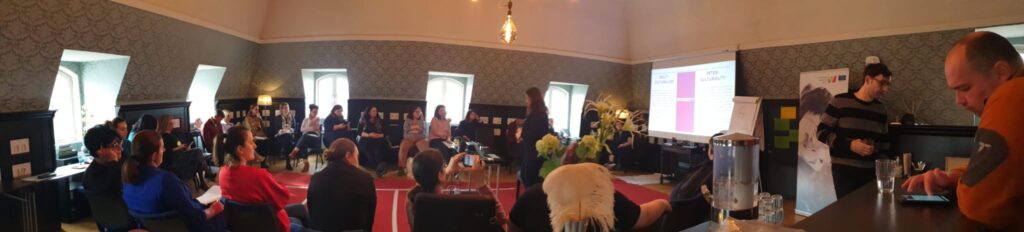
At the end of March (March 24-27, 2022), school teacher Adriana Mititelu (Tulcea county) was selected to attend a training session in Norway, provided by the European Wergeland Center in Oslo. On this occasion, she sent us some information about the activities she was involved in:
As a participant in the project Children and youth integrated for a better world , I learned with great interest about the opportunity to participate in training session in Norway on a topic of real interest and of great relevance Inclusive education and skills for a democratic culture. With some reluctance I filled out the registration form and here I was selected among the 24 participating teachers.
In the first day, I participated to the course held by Elizabeth Kasa, trainer from of the Council of Europe, namely Inclusion and the reference framework of competences for democratic citizenship. Emphasis was placed on: clarifying the terms exclusion-segregation, integration-inclusion; the role of the EU in the inclusive education approach and the Salamanca Declaration (1994). The Declaration promotes the principles of integration and the recognition of the need to act for the creation of “schools for all”, institutions that include all children, with respect for differences between them, support students in the learning activity and respond to individual requirements. It was insisted on the idea that an inclusive school must include in the education process all children, regardless of physical, intellectual, social, emotional, linguistic or other conditions.
There were discussions related to the difficulties faced by teachers in Romania/Norway and the conclusion was that Inclusion does not take place until the school culture changes (in terms of values, behaviors and approach).The program of the second day was related to the Whole school approach, trainer: Valentina Papeikine, Wergeland Centre. WSA involves the involvement of ALL members: school administration, teachers, students, parents, local community members.
- at the level of teachers: curriculum, methodology, extracurricular activities, the inclusion of activities that involve the development of democratic skills in the act of teaching, interdisciplinary activities
- at the administrative level: student involvement in school decisions
- at the community level – involvement of parents in the decision-making process, interschool partnerships, partnerships with local institutions.
- examples of good practice/Norwegian experiences
- a major goal for Norwegian education throughout the 13 years of schooling is language confidence and belief in one’s own culture as a basis for identity development, respect for other cultures, active social participation and lifelong learning
- The role of teachers is essential to an effective education system (they have the power to bring about change – to make students and parents feel heard and valued)
Also then, we participated in a role-playing game, in which we were divided into groups of trainees, organized as teachers, parents, principals, students. Each group had to establish three fundamental needs for the school, and at the end a priority need was negotiated between the groups. Given that a former graduate of the school wanted to grant a sponsorship of 25,000 euros, a dialogue took place with the sponsor, each trying to convince him of the need considered the most important.
The third day was dedicated to the education of Roma children and their integration into the collective – trainer: Ramiza Sakip, from Council of Europe. The discussion looked at the UNICEF and UNESCO framework regarding the integration of Roma children and recommendations regarding the approach of meetings with parents and the integration of Roma students into the collective.
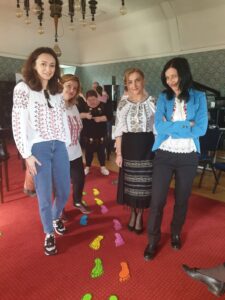
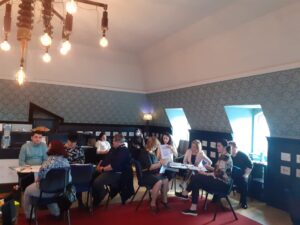
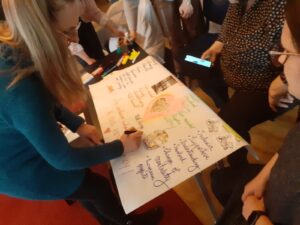
- A positive atmosphere, encouraging cooperation and a sense of belonging to a group. The feeling of belonging to a group helps to increase self-confidence and reduce the fear of failure in completing tasks. Ways to promote group cohesion: interactive group activities, games or sports activities.
- Let’s make sure that all children feel special and valued by formulating positive assessments at all times, without making comparisons between children, without creating hierarchies in the group. You can design activities that make each child feel special.
- Stimulating children to develop independent thinking, make decisions and find solutions to problems. If a task is perceived as too difficult or if problems arise within the group, instead of rushing to give solutions or decide what you think is appropriate, it is preferable to ask questions and offer alternatives.
- Avoiding negative judgments and evaluations of their performance and choosing positive wording. If a task is not successfully completed, instead of saying “try harder next time,” you can choose to conclude “we’ll have to find a better way to learn how to do this”.
- Providing opportunities for mutual aid. By creating situations where children have the opportunity to help a classmate and be helped, you boost self-esteem and encourage pro-social behavior.
- Connecting educational activities with cultural elements with which children are familiar. In particular, the inclusion of links with Roma culture will have a positive effect on the self-esteem of Roma children, but it will also facilitate the learning process (it is easier to learn starting from something familiar) and develop positive attitudes in other children.
- Children will be encouraged to relate to positive role models. It is useful to involve Roma adults who can represent successful role models that Roma children can identify with, for example, with young Roma who recognize their Roma ethnicity and who can also speak Romani.
Prof. înv. primar
Adriana Mititelu
 Read More
Invitation to the PN2019 intermediary press conference – July 28, 2022, 10 a.m
“Ștefan cel Mare” University of Suceava, as the Project Promoter, together with its partner – the Association for Support in the Development of the Social Economy – Inclusion, Cooperative Responsibility, Social Entrepreneurship (IRCAS) from Tulcea invites you on Thursday, July 28, 2022, from at 10.00, to attend the intermediary press conference of the “Integrated children and youth for a better world” project. The event will take place online, on the Google Meet platform: https://meet.google.com/esz-isqp-awr . Read MoreResults achived after the first phase of project implementation
On July 28th, 2022, “Ştefan cel Mare” University from Suceava in partnership with the Association for Support in the Development of the Social Economy – Inclusion, Cooperative Responsibility, Social Entrepreneurship from Tulcea, organized a press conference in which were presented several intermediary results within the project “Integrated children and youth for a better world”.
The project benefits from a grant of € 1,212,665 provided by Norway through Norwegian Grants, within the Local Development Programme. The aim of the project is the integrated and innovative approach of several target groups consisting of: 80 children and young people with special educational requirements; 790 children and young people at risk of early dropping out of school; 211 teachers and 500 parents/guardians of children at risk; 10 professionals/volunteers from the sphere of social services; 150 children/young people, respectively 50 of their parents/guardians, who interact with children and young people from the main target group – in order to increase the degree of social inclusion of children from three development regions in Romania.
The online event was attended by representatives of the Romanian Social Development Fund, implementation team, principals and teachers from the 14 associated schools – suppliers of the target groups (from Suceava county – Panaci Secondary School, Şerbăuți Secondary School, Siminicea Secondary School, Măriței Secondary School, Drăgoiesti Secondary School, Pătrăuți Secondary School, Mitocu Dragomirnei Secondary School; from Botoșani County – Manoleasa Secondary School; from Harghita County – “O.C. Tăslăuanu” Bilbor Secondary School ; from Tulcea County – Valea Nucarilor Secondary School, “Nichifor Ludovig” Niculitel Secondary School , Beștepe Secondary School, Frecăței Secondary School, “Vasile Alecsandri” Nufărul Secondary School).
During the meeting were emphasized several aspects regarding the fulfillment degree of the assumed indicators, as well as the future activities in the project. So far:
- were elaborated the specific methodologies regarding the identification and monitoring of children at risk of dropping out of school / children with possible learning difficulties, psychobehavioral difficulties or disabilities; was carried out the selection procedure of each target group.
- were selected/monitored 587 children at risk of early dropping out of school and 87 children with possible learning and psycho-behavioral difficulties from associated schools.
- the children target group benefited from “school after school” educational support services and was involved in various activities, regarding environmental protection, nature orientation, sports, team work and team bulding, creative activities: painting, dance, theater, photography, music, pottery, knitting, origami, ikebana, tracery, science lab etc.
- 170 teachers participated to training courses, regarding work with children and young people at risk of leaving school early, respectively work with children and young people with special educational needs (81% of the assumed target).
- were provided parental education courses for parents/guardians of children at risk of dropping out school/special educational needs in the target group: 380 parents of children or young people at risk of early school leaving (approx. 80% of the assumed target) and 42 parents of children or young people with special educational needs (175% of the target).
Participating teachers particularly appreciated project activities, emphasized the interest shown by the children and the specific role of the project in strengthening closer ties between families-school-community and school performance of pupils. Regarding the aspect, the principals of the secondary schools in Panaci and Siminicea recalled that the additional hours of Romanian Language&Literature and Mathematics, within the “school after school” support program, were positively reflected in the results obtained at the National Assessment (the graduation rate was higher than before, up to 100%).
The specific activities in the project will continue in the next school year for another 283 children and other actions are planned – such as inclusive education and school segregation fight, parenting education programs (for 120 parents), organization of a postgraduate course approaching inclusive education and special needs/disability issues (for 46 teachers).
The project “Integrated children and youth for a better world”, code PN2019, within the call INCLUSIVE EDUCATION FOR CHILDREN AND YOUTH AT RISK, is implemented by the “Ştefan cel Mare” University of Suceava (Project Promoter) and the Association for Support in the Development of the Social Economy – Inclusion, Cooperative Responsibility, Social Entrepreneurship from Tulcea (Partner) between January 2021 – December 2023.
More details are provided on the websites of the Funding Agency www.eeagrants.ro, of the Programme Operator – www.frds.ro and project’s web pages – https://ctil.usv.ro/ .Read MoreOpinions and results: first phase of project implementation
Participating students:
So far, within the project framework, 587 children at risk of dropping out and 87 children with possible learning and psycho-behavioral difficulties from the associated schools have been selected/monitored. They represent 78%, respectively, 109% of the assumed targets. The target group of children benefited from “school after school” educational support services, education for environmental protection, orientation in nature, sports, team work and team building, creative activities: painting, dance, theater, photography, music, pottery, knitting, origami, ikebana, tracery, science lab etc. The additional classes provided for the 8th grade students in Romanian Language&Literature and Mathematics, within the “school after school” support program (Act. 2), was positively reflected in the results obtained at the National Assessment – the percentages of those who graduated the secondary school cycle in 2022 being higher than in the previous year:
| School Unit | Pass rate at the National Assessment (%) | Percent growth | |
| 2021 | 2022 | ||
| Panaci | 40 | 100 | 60% |
| „O.C. Tăslăuanu” Bilbor | 83 | 85 | 2% |
| Șerbăuți | 72 | 73 | 1% |
| Siminicea | 81 | 96 | 15% |
| Măriței | 62 | 76 | 14% |
| Drăgoiești | – | 77 | – |
| Manoleasa | 48 | 57 | 9% |
| Valea Nucarilor | 0 | 67 | 67% |
| „Nichifor Ludovig” Niculițel | 61 | 75 | 14% |
| Frecăței | 64 | – | – |
| „Vasile Alecsandri” Nufărul | 70 | 85 | 15% |
(conform evaluare.edu.ro)
On average, the transition rate in upper secondary education (9th grade, ISCED 3) in supported schools was 79.1% in 2022, compared to 58.1% in 2021. The extracurricular performances of the students from Nichifor Ludovig School in Niculitel (Tulcea County) should also be mentioned. Here, the activities carried out and sport equipment provided within project had an important contribution to the stimulation of students’ talents, development of new skills or cultivation of interest for sports. At the county competition “Olympic Day”-Table Tennis, the participating students included the target group obtained the 3rd, 4th and 5th places.
- 8th grade students, Siminicea Secondary School, Suceava County: For us, the project Integrated children and youth for a better world, through the School after School program, was a real opportunity in the preparation of the Romanian Language National Assessment exam. During the classes we were able to: fix our “losses” from the online school period, clarify any misunderstandings lately discovered, read and interpret several literary and non-literary texts, become able to compare/associate them, solve more training tests. We therefore thank the initiators and coordinators!
- Andreea, 8th grade, Drăgoieşti Secondary School, Suceava County: From the beginning I was excited, I had never participated in something like this before, and the prospect of preparing for the National Assessment together with my colleagues and under guidance careful smiled at me.
- Alexandra, 8th grade, Drăgoieşti Secondary School, Suceava County: It was very good, many times I didn’t take money from home for snacks, I had what I received from the project: everyone the same – a fruit, a croissant, biscuits, but, above all, I had an appetite to learn. Week by week I knew more and gained more courage for the exam. Thank you, come next year to my school, there are other colleagues who need such help!
- Daniela and Petruţa, 8th grade, Drăgoieşti Secondary School, Suceava County: This school year I participated in the project Integrated children and youth for a better world .The aim of the project was to provide school-by-school educational support services for 30 colleagues from the 8th grade between January and June 2022. At first I did not understand its role, but, after activities performed weekly, I have noticed that my level of knowledge is improving and I am gaining more courage in my preparation for the National Assessment.
- Lucian, 8th grade, Drăgoieşti Secondary School, Suceava County: All the hours I have spent during this project, built up my confidence that I can do better in my final exams and I want to thank you for this ! Thank you also for the great meal, I enjoyed the food to the last bit.
- Vasile, 8th grade, Drăgoieşti Secondary School, Suceava County: At first, it was a little harder for me to get used to the new program, which required more of my free time. As the recovery and remediation activities for the two exam subjects took place and the attention of those offering support focused better on my needs, I began to look forward to the project hours – being convinced that success in the exam is closer !
Parents from the target group:
Within the project, parental education activities were provided for parents/guardians of children at risk of dropping out school / with special needs: 380 parents of children or young people at risk of leaving school early (approx. 80% of the target assumed) and 42 parents of children or young people with special needs (175% of the target).
- Ioana MARTINIUC, mother of the student Bianca Martiniuc, from Călineşti Enache Secondary School (Măriţei, Suceava): My daughter participated in the activities within this project and I think they were very welcome – well organized and very useful for children. As well as the packages of sweets, received by them.
- Roxana ZAMĂ, mother of the student George Sebastian Grijincu, from Călineşti Enache Secondary School (Măriţei, Suceava): My son participated in all the activities of the School After School program. I think these went in a normal manner and helped my child a lot.
- Ana Simona PANŢIRU, mother of the students Melania(3rd grade) and Laurenţiu (4th grade), from Călineşti Enache Secondary School (Măriţei, Suceava): My children participated in the School after School activities and were very excited to spend extra time with their classmates. Everything was OK !
Teachers from the target group:
170 teachers benefited from training courses about working with children and young people at risk of early dropping out school, respectively working with children and young people with special needs (81% of the target assumed). As a result of the involvement in the implementation of the project, four of them also attended a training course held in Oslo, Norway, with the theme of Inclusive education and skills for a democratic culture.
- Mirela VERDEȘESCU-BUZILĂ, principal of the PANACI Secondary School, Suceava County: Among other benefits, the project Integrated children and youth for a better world made the relationship between school – community – family become closer and more connected.
- Liliana-Cristina RUSU, teacher in primary education at the Şerbăuţi Secondary School, Suceava County: Only words of praise to those who made this collaboration possible! It was a special surprise that, in addition to the “school after school” program, I was selected to attend the second group of the course held in Norway! The skills for a democratic culture were put to good use in the classroom, capitalized on by the fact that my students set the program of festivities to mark the end of primary school!
- Mihaela VÎLCAN, principal of the O.C. TĂSLĂUANU BILBOR Secondary School, Harghita County: Let me thank you for the opportunity to be partners in this very welcome project for our community. Secondly, I would like to thank you for the opportunity to attend the training course held in Oslo, during which I realized that our institution will function effectively only if it is based on a culture of democracy where education is an essential component. I met colleagues from all corners of the country, from education or different fields, we exchanged impressions and learned from each other, at the same time becoming “ambassadors” of a democratic culture in the communities we represented.
- Adriana MITITELU, teacher in primary education at the Frecăţei Secondary School, Tulcea County: As a participant in the project Children and youth integrated for a better world, I learned with great interest about the opportunity to participate in training session in Norway on a topic of real interest and of great relevance Inclusive education and skills for a democratic culture. With some reluctance I filled out the registration form and here I was selected among the 24 participating teachers. It was a useful course, from which we all had to learn – social inclusion and democratic education can only be achieved with the participation of all factors. The course was well structured, with interactive activities and involved trainers. I disseminated the new knowledge acquired to my colleagues, parents and students, by presenting the activities carried out, with an emphasis on integration and democratic education.
Trainers/experts providing activities:
- Monica TURTUREAN, lecturer, Faculty of Educational Sciences, “Ștefan cel Mare” University of Suceava: I was greeted with many smiles and good cheer at the Secondary School “O.C. Tăslăuanu” Bilbor (Harghita County), where I met a group of curious students eager to learn new things. They welcomed me as if we had known each other forever, I felt a lot of warmth and a feeling of well-being in their souls.The atmosphere was very relaxed, engaging, and my discreet interventions had the role of stimulating the discussion. Questions related to hygiene and healthy eating wanted to be answered as fully as possible, and the students had a great need to feel validated throughout our meeting; we took care of this aspect, which was by no means free, but was a consequence of their involvement, of the fact that they responded with interest. They constantly had their hands raised, they found new explanations for everything I asked, they looked with great interest for other examples than those provided by me to show me that they know, that they master a lot of information, but also because that’s how they saw learning, as a total involvement, no mean lines and no raising of the tone. As a conclusion, this activity filled my soul with beauty, with positive emotions because I connected with innocent young people, full of energy, eager to learn new things, constructive receptive to everything.
- Marius EȘI, lecturer, Faculty of Educational Sciences, “Ștefan cel Mare” University of Suceava: The activity (in Manoleasa Secondary School, Botoşani County) made the time compress and the joy remained on everyone’s faces. At the end of it, we all enjoyed a very good and tasty ice cream, parting with handshakes, with a slight regret and with the hope of an equally beautiful and pleasant reunion in the future. There would be much more to say about such an educational approach, beyond the emotions felt by each participant. I can only say that I met some wonderful children full of life, restless in the good sense of the word, eager to know, to color, to communicate. They always tried through the behavior they displayed to express themselves in a personal way, to show what they did, what they know or what they learned during the activity carried out. It is certain that the education of children is like a flower, a flower that always needs to be watered, sprinkled with a lot of care and affection, so that it is pleasing to the eye whenever it is looked at. Let’s not forget that education can only be perfected and transmitted through the children we always have close by, beside us, as educators, because, basically, they teach us how to laugh, smile, enjoy everything moment in our own lives.