
Rural School Between Intervention and Self-Sustainability: Lessons from the Six-Year Journey of the CTIL Project
The project entitled “Integrated Children and Youth for a Better World” (CTIL), implemented between January 2021 and December 2023, represents an educational initiative of strategic importance, designed to alleviate acute phenomena of social exclusion and school dropout in rural Romania. Funded through the Norwegian Grants under the “Local Development, Poverty Reduction and Enhanced Roma Inclusion” Program, with a total budget of approximately 1.21 million euros, the project was implemented by the “Ștefan cel Mare” University of Suceava (USV) as the project promoter. This academic approach was reinforced through solid partnerships with the Suceava County Centre for Resources and Educational Assistance (CJRAE) and the Association for Support in the Development of Social Economy – Inclusion, Cooperative Responsibility, Social Entrepreneurship (IRCAS) in Tulcea. The structural design of the intervention targeted a group of approximately 750 children and young people at severe risk of early school leaving or with special educational needs, originating predominantly from marginalized, geographically isolated rural communities, or those affected by socio-economic vulnerabilities across the counties of Suceava, Botoșani, Harghita, and Tulcea. By focusing on risk categories such as children from low-income families, Roma children, or those with parents working abroad, the program aimed not merely at a strictly academic remediation, but at a holistic transformation of the entire local educational ecosystem.”.
The major relevance of the project lay in the complexity and innovative character of its activities, specifically designed to overcome the geographic and material barriers that traditionally limit access to quality education in disadvantaged regions, such as isolated mountainous localities or the Danube Delta. The central pillar of direct pedagogical intervention was represented by the “after-school” support sub-activity, focused on supplementary preparation for 8th-grade students in core subjects—Romanian language and literature, and mathematics—with the direct goal of optimizing performance in the National Assessment. Beyond this curricular backbone, the project integrated an extensive range of non-formal activities aimed at developing the creative and socio-emotional potential of young people, including environmental education, outdoor orientation, sports, science labs, artistic activities (theater, dance, photography, music, pottery), and techniques for fostering camaraderie. Equally, long-term sustainability was ensured through parental education measures designed for 268 parents and guardians, as well as postgraduate programs and international specialization internships for teaching staff, such as the Oslo training course dedicated to the culture of democracy and inclusion—elements valued by school managers as essential for enhancing the operational efficiency of partner institutions.”.
The immediate impact of this active implementation phase (2021–2023) is eloquently reflected in the evolution of quantitative indicators regarding the pass rate (grades equal to or higher than 5) in the National Assessment across participating school units. A longitudinal data analysis highlights spectacular jumps in academic performance that directly coincide with the period of intensive assistance provided by the project. For example, Panaci Secondary School recorded a pass rate of only 40% in 2021; however, as a result of the integrated measures applied, it reached an absolute level of 100% in 2022 and 2023. Similar upward trajectories are observed at Măriței Secondary School, where the pass rate grew steadily from 62% in 2021 to 76% in 2022 and 87% in 2023, respectively. Likewise, school units such as “O.C. Tăslăuanu” Primary and Secondary School in Bilbor and Șerbăuți Secondary School experienced substantial performance peaks in the final implementation year (2023), reaching rates of 91% and 92% respectively, starting from considerably more modest initial thresholds. Even in communities with a profound degree of structural vulnerability, such as Primary and Secondary School No. 1 Manoleasa, the student success rate rose from 48% in 2021 to a remarkable 82% in 2023, indisputably demonstrating the immediate efficacy of the remedial and support programs offered by the team of experts from USV and its partners.”.
The transition to the sustainability period (2024–2026) reveals complex nuances regarding the internalization of successful practices and the resilience of the rural school system in the absence of active external financial flows. Statistical data show that in certain communities, project benefits were deeply institutionalized, generating lasting positive effects. Măriței Secondary School constitutes a remarkable example of self-sustained progress, continuing its upward curve in the post-implementation phase as well, reaching 93% in 2024, 94% in 2025, and a historical maximum of 95% in 2026. Complementarily, Panaci School managed to maintain its status of excellence, achieving a 100% pass rate in 2024 and 2026, with a slight and natural fluctuation of 92% in 2025. However, the sustainability period also highlights the intrinsic vulnerabilities of rural education, closely linked to demographic variations from one generation to another and the severity of underlying socio-economic issues. The sharp declines recorded in 2026 at Manoleasa School (down to 24%) or the severe oscillations at Drăgoiești School (which dropped to 25% in 2024 before rising to 57% in 2025 and falling back to 41% in 2026) underline that, although the project provided important methodologies and resources, consistently maintaining high standards requires a permanent systemic effort. On the other hand, cases such as “Vasile Alecsandri” Nufărul School, which after a severe regression in 2023 (14%) underwent a gradual and steady recovery during the sustainability years (41% in 2024, 53% in 2025, and 56% in 2026), demonstrate that the seeds of pedagogical and community resilience planted during the project continue to bear fruit and stabilize schools during difficult times.”.
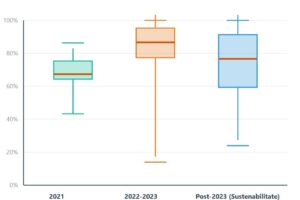
Academic performance in the National Assessment across partner schools (pass rates >= average grade 5). The chart indicates a clear upward trajectory of the central line inside the box (median), which increases significantly from 64.0% in the pre-implementation phase (2021) to 83.5% in the direct support phase (2022–2023), proving the effectiveness of the remedial and support programs. During the implementation period, a concentration of most schools towards higher values is observed (Q1 rises to 74%), reducing the underperformance gap. In the sustainability phase, the box widens downward again (Q1 drops to 56%), reflecting the emergence of vulnerable generations or the reappearance of structural gaps upon the withdrawal of financial assistance, although the median remains at a higher level compared to the baseline (73.5% vs. 64.0%). Data source: https://static.evaluare.edu.ro.
In conclusion, the CTIL project developed by the “Ștefan cel Mare” University of Suceava constituted a true model of best practice in the field of educational inclusion and support provided to youth from disadvantaged backgrounds. Correlating the qualitative analysis of its objectives with the dynamics of academic results clearly shows that the intervention served as a vital catalyst for the growth and empowerment of young people in partner schools. It offered them not only the cognitive tools necessary to pass national exams, but also long-lasting social and cultural capital. The inherent fluctuations during the sustainability period do not diminish the project’s value; rather, they argue academically for the necessity of replicating and permanenting such integrated support models—the only ones capable of ensuring genuine equity and stable development of human capital in rural Romania.”.